

While the US economy might be tanking, one can still find treasures for little money outside of dominant locations.
I went to my local bike store on Saturday looking for a bike for my son while they were having a sale. I didn’t find anything for him there, so I headed across the street to the thrift store to see what they had to offer – a huge sale.
I found a basic black bookcase – not high quality, but serviceable. I still have books in boxes because I lost a big bookcase in my last move (close to a year ago now). The price tag said $10. I also picked up a Kwame Alexander paperback in good condition. The whole thing rang up to $4.50. The bookcase was 60% off!
I find it distressing these days to follow the news. I’m trying to balance my mental health with my duties as an American citizen. I have made and continue to call representatives and senators, as well as send emails. But the waves are huge and some days it’s impossible to not feel like one is drowning.
I hope it’s because it’s the end. I’m ever hopeful. I’ve been ready for the end of patriarchy and capitalism gone wild my whole entire life. I love reading about matriarchies (this explanation is by Lainey Molnar) as separate entities entirely than patriarchies. Entirely different ways of thinking, being, and living.
So anyway, the next day I went to a different thrift store – a Goodwill. And I found a textile from India made from repurposed fibers. A rug for under $5. I have purchased these rugs from other Goodwills in Tucson in the past. They are sturdy little rugs and the one I just got matches the tile by the back door.

How is this under $5?
I do not understand the world economy, let alone the US economy.
I get that India must be set up to be able to make these items at incredibly low prices, but doesn’t shipping cost something? I just sent a very lightweight handmade card about 1500 miles in the US and that cost over $5. The distance to India from Tucson is over 8700 miles. I don’t get it.
Of course all of these new tariffs created by the current administration are a stupid idea. But so was re-electing the felon. The only thing the orange thug has ever been consistent about in his life is putting his own self-interests first.
Did anybody else read Doonesbury back in the 1980’s and 90’s? One of the comic strip’s characters worked for him back when he was a shady real estate developer who wanted something fancy painted on his yacht.
So this is a long post, because I haven’t been posting much lately. I’ve been busy with other aspects of life, including weaving.
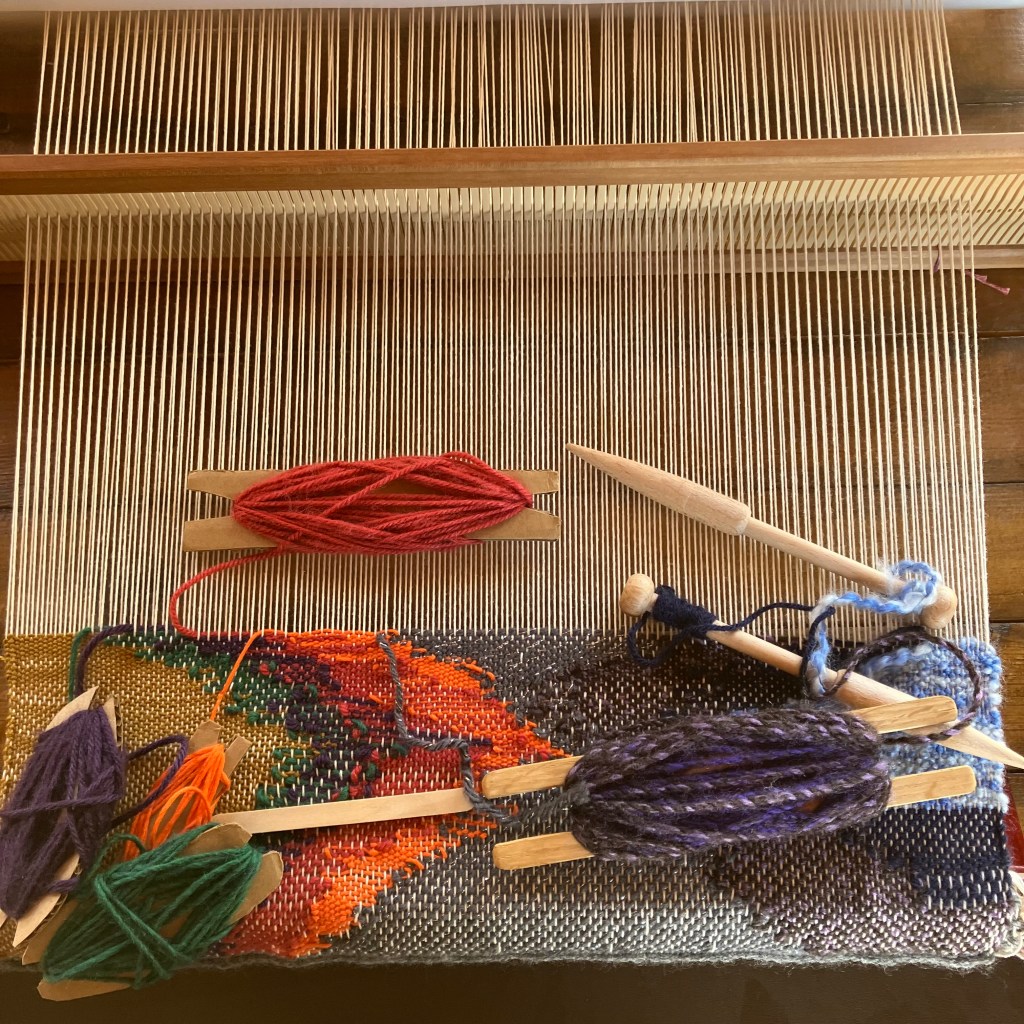
I’m making snake finger puppets as well because I wanted to try and weave a puppet for an actual kid – maybe even the five year old that I work with. I don’t envision ever selling these items. How can one come up with a way to price fairly and equitably in an economy that’s rigged against one?

Today I went to my weaving guild’s meeting and stash sale. I got some incredible deals at the sale – one of which was a Turkish drop spindle. I bought it from an expert cotton spinner who just got back from instructing a spinning class in Ireland. She showed me how to use it when I told her I was just starting to learn how to spin with a drop spindle.
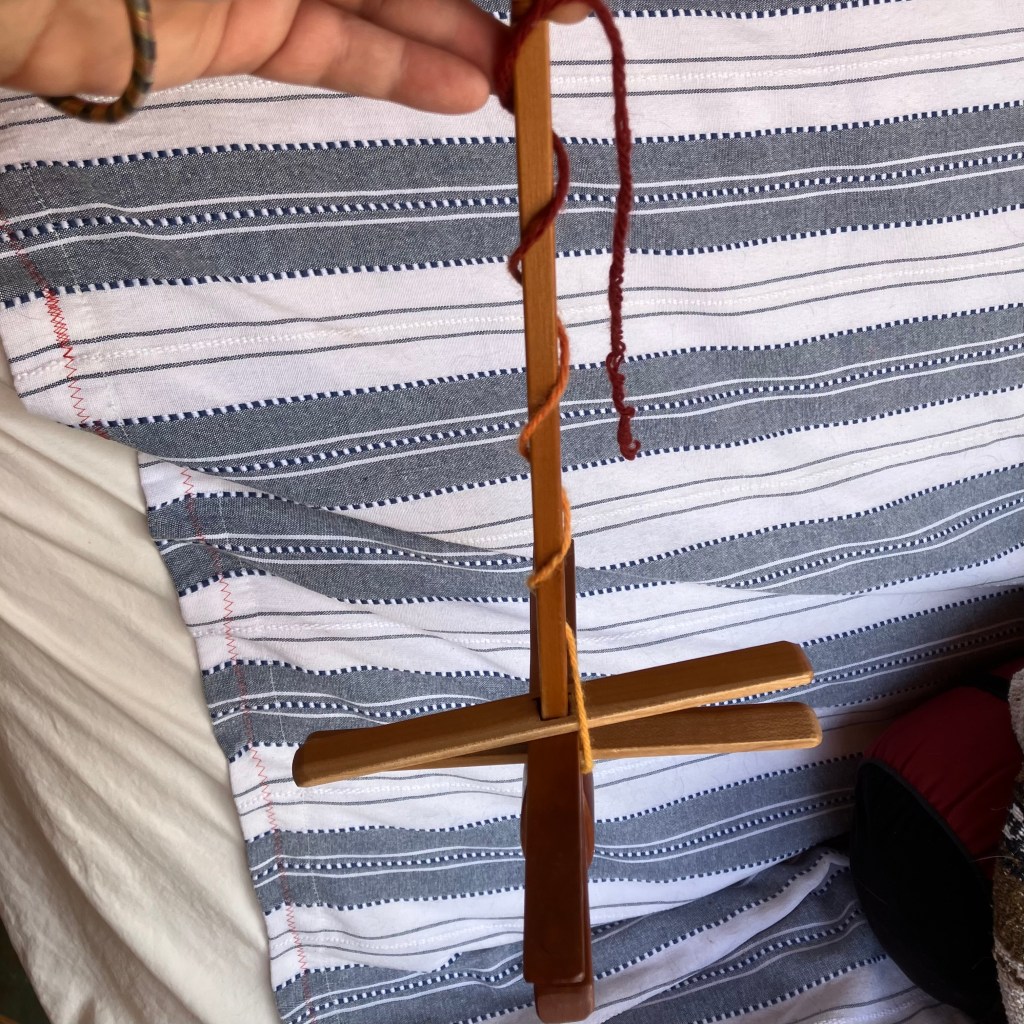
The spindle was $5. The lesson and the mini conversation were bonus.
We talked about spinning bulky yarns with uncommon textures. Those are the kind that I do best.

I am amazed by this woman – her age and experience. She’s 90 years old!
The fiber arts community seems to me to be both a space of rebellion and a matriarchy. Maybe I’ve just been watching a lot of Andor, but to spend enormous amounts of time creating items that are mostly outside of any economic system – seems kind of rebellious. And to do it repeatedly, over and over again. (Some fiber artists may make some money pursuing their art, but most just do it in their “free” time).
Handmade fiber items seem much more undervalued than many other handmade items made from leather, wood, or metal.
Gee, I wonder why?
The matriarchy is here, for who knows the fiber arts better than the grannies? The wise women who have spent years learning various crafts and techniques and sharing them. Some may have even learned from their mothers or grandmothers.
We have technology to help connect, teach, and learn from afar.
What we do not yet have is a system for fair and equitable access to tools and knowledge, or markets for equitable compensation. So much has been lost over the years.
I’m listening to Embers of the Hands: Hidden Histories of the Viking Age by Eleanor Rosamund Barraclough. I’ve learned that the tiny village portrayed in Vikings (I love that show!) – Hedeby – became a major trading site later on. And fiber was a huge part of the Viking economy. Lots of sails were needed for those dragon boats that went in all directions.
I believe that many of the fiber arts have been intentionally undervalued since around the beginning of the industrial age. It has been a predominately female sphere – that’s one reason to undervalue it. Also, dominant culture wants people to have to rely upon machines for their basic needs – like textiles and food. And those machines aren’t even located locally anymore. My grandfather used to work as a “beamer” in a textile factory in Philly. I’m pretty sure those jobs don’t exist anymore.
It’s much cheaper for the factory to be located in India, Vietnam, or some other SE Asian country now. Hand-crafted items can be imported from other parts of the world at incredibly low prices. Why bother investing in local artisans or products? Capitalism run amok says cheaper is always better.
Well I am reclaiming lost ancestral knowledge (or trying to). Spinning and weaving, growing food, experimenting in making toys and puppets, and repairing broken things. These can all be considered rebellious acts these days in this country. They are certainly acts born of desires to resist conventions.
That’s a lot of thoughts for $5.
 Ra's Spiral Path
Leave a comment